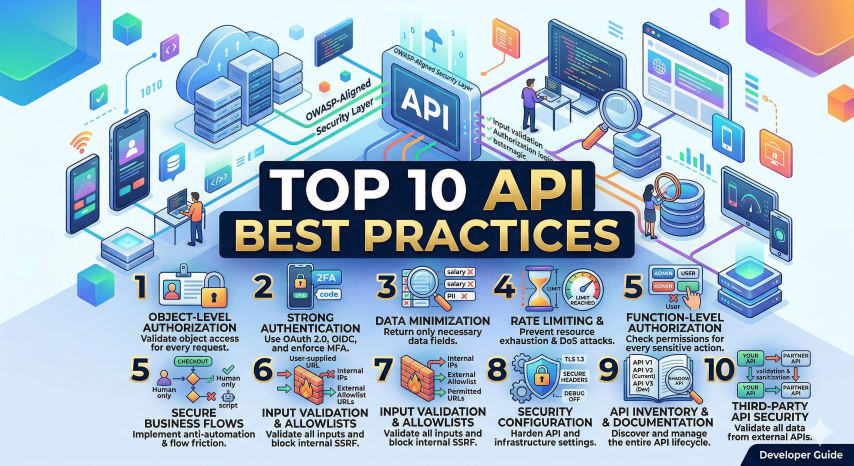
Top 10 API Best Practices
Building robust and reliable APIs is crucial for any modern application. This post distills the essence of excellent API design into actionable best practices. Key takeaways include: * **Prioritize Security:** Implement robust Authentication (OAuth2 and API Keys) and strict Authorization checks to verify resource ownership. Always enforce HTTPS to protect data in transit. * **Embrace Consistency:** Follow RESTful principles for predictable resource naming, intuitive URLs, and standard HTTP methods. * **Plan for Evolution:** Implement clear API versioning to manage changes gracefully without breaking existing integrations. * **Document Thoroughly:** Provide comprehensive, up-to-date documentation (e.g., using OpenAPI) with clear examples. * **Handle Errors Gracefully:** Deliver consistent, informative error messages using standard HTTP status codes and detailed error bodies. * **Optimize Performance:** Implement pagination, rate limiting, and caching to ensure efficiency, prevent abuse, and enhance scalability. * **Validate Inputs Rigorously:** Sanitize and validate all incoming data to maintain data integrity and protect against vulnerabilities. Adopting these practices will significantly enhance the usability, security, and maintainability of your APIs, empowering developers and ensuring long-term success.
Whether you're building a lightweight microservice or a massive enterprise gateway, your API is effectively the "front door" to your data. If you leave that door off the latch, someone is going to wander in—expected or not.
With the OWASP API Security Top 10 as our guide, here are 10 best practices to ensure your APIs are as solid as they are functional. No buzzwords here—just clean, actionable engineering.
1. Implement BOLA-Proof Authorization
OWASP API1: Broken Object Level Authorization (BOLA)
BOLA is the most common API vulnerability. It happens when a user can access a resource they don't own by simply changing an ID in the URL (e.g., changing /api/orders/123 to /api/orders/124).
The Fix: Never trust the ID provided in the request alone. Always verify ownership in your database query.
// BAD: Just takes the ID and returns data
app.get('/api/orders/:id', (req, res) => {
  const order = db.find(req.params.id);
  res.json(order);
});

// GOOD: Filters by the authenticated user's ID
app.get('/api/orders/:id', (req, res) => {
  const order = db.findOne({ id: req.params.id, userId: req.user.id });
  if (!order) return res.status(404).send("Order not found");
  res.json(order);
});
2. Use Modern Auth (and do it right)
OWASP API2: Broken Authentication
Standardize on OAuth 2.0 or OpenID Connect. Avoid creating custom "secret key" schemes or rolling your own crypto.
- Pro-tip: Keep your JSON Web Tokens (JWTs) short-lived. If a token is stolen, you want its "shelf life" to be minutes, not days.
- Asymmetric Signing: Use RS256 so only your auth server can issue tokens, but any service can verify them using a public key.
3. Strict Input Validation
OWASP API5: Injection
If it comes from the client, treat it like it’s radioactive. Use a schema validator like Joi or Zod to enforce types, lengths, and formats before your business logic even touches the data.
Try this locally: Install a validator and try to pass a string where a number is expected. Your API should bark back immediately with a
400 Bad Requestbefore it ever reaches your database.
4. Rate Limiting: Don't Let Them Spam You
OWASP API4: Unrestricted Resource Consumption
Without limits, a simple script can crash your server or rack up massive cloud bills. Your API should have a "fair share" policy.
const rateLimit = require('express-rate-limit');

const limiter = rateLimit({
  windowMs: 15 * 60 * 1000, // 15 minutes
  max: 100, // Limit each IP to 100 requests per window
  message: "Too many requests from this IP, please try again later."
});

app.use('/api/', limiter);
5. Block Mass Assignment
OWASP API3: Broken Object Property Level Authorization
This happens when an attacker sends extra fields in a JSON body (like {"isAdmin": true}) and your API blindly saves them to the database record.
The Fix: Use allowlists. Explicitly pick the fields you actually want to update rather than spreading the entire req.body into your database.
// Instead of: db.update(req.body)
const allowedFields = {
  name: req.body.name,
  bio: req.body.bio
};

db.update(allowedFields);
6. Contract-First Design with OpenAPI
Building an API without a spec is like building a house without a blueprint. Use OpenAPI (Swagger) to define your endpoints first. This automates documentation and allows you to generate client libraries, ensuring your code stays DRY (Don't Repeat Yourself).
7. Version Your API Gracefully
Don't break your users' implementations. Use versioning in your URL (e.g., /v1/users) or via custom headers. When you release /v2, keep /v1 alive until you have signaled a formal deprecation period.
8. Fail Safely (No TMI)
OWASP A10:2025: Mishandling of Exceptional Conditions
When your code crashes, never send the user a 50-line stack trace. It's essentially a roadmap for hackers to understand your internal directory structure and dependencies.
- Test it: Try calling an endpoint with a malformed ID. If you see "Database Error at line 42 of connection.js", you're oversharing.
- Solution: Return a generic "Something went wrong" to the user and log the details internally.
9. Maintain a Clean Inventory
OWASP API9: Improper Inventory Management
"Shadow APIs" (old, forgotten versions) are massive security gaps. If you have an unpatched v1 still running in production, that is where a breach is most likely to occur. If an endpoint isn't being used, decommission it.
10. HTTPS Everywhere
In 2026, there is no excuse for unencrypted traffic. Use TLS 1.3 to encrypt data in transit. It’s the difference between sending a postcard and sending a sealed, armored envelope.
The Bottom Line
Security isn't a "one and done" task; it's a continuous engineering discipline. Building a secure API isn't just about blocking bad actors—it's about building trust with your users and ensuring that your application is resilient, predictable, and professional. By following the OWASP guidelines and keeping your code clean, you're not just writing software; you're building a reliable foundation for the future.
Community Discussion
0 Comments
Found this helpful?
If you enjoyed this technical tale, consider supporting my work.