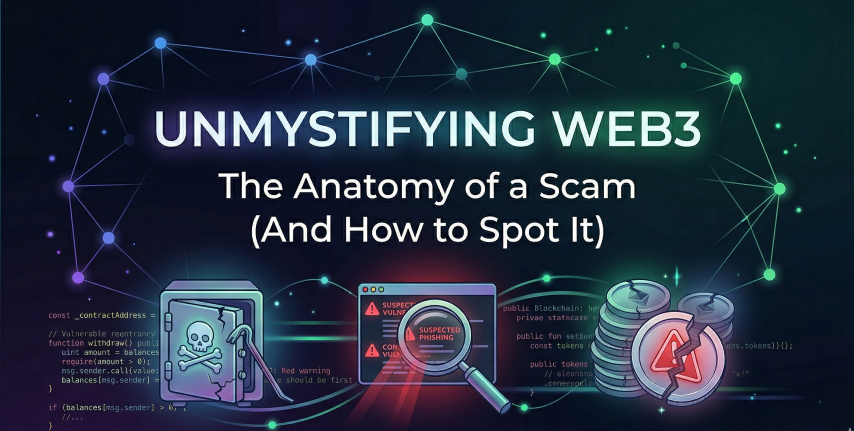
The Anatomy of a Scam (And How to Spot It)
Tokens are just applications running on a decentralized database, so where does the €10 million market cap come from? In part two of our Web3 series, we explore the illusion of value, how a lack of "security by design" enables rug pulls at the code level, the evolution of market manipulation, and what an actually healthy token looks like.
The Anatomy of a Scam (And How to Spot It)
In our first post, we stripped away the hype to look at the core architecture of Web3: blockchains are just distributed databases, wallets are just offline cryptographic locks, and tokens are just small applications (smart contracts) running on top of that database.
If deploying a token is as simple as pushing a few lines of boilerplate code to a network, where does the value actually come from?
The harsh reality of the current Web3 landscape is that much of it comes from thin air, human psychology, and deliberate architectural vulnerabilities. Let's look at how bad actors exploit this system, progressing from basic code flaws to advanced psychological manipulation.
1. The Illusion of Value
Tokens can be useful. They can act as digital loyalty points, access keys for APIs, or governance votes for decentralized organizations. However, the vast majority of "memecoins" today serve no functional purpose.
When you trade €100 for a new token, you aren't buying equity in a revenue-generating company. You are simply exchanging money for a ledger entry on a database. The token's value is purely speculative, driven entirely by supply and demand. Because there is virtually no barrier to entry, malicious actors orchestrate mathematically guaranteed scams by exploiting this speculative nature.
2. The Code-Level Scam: The Basic "Rug Pull"
A basic "Rug Pull" relies on terrible smart contract code. It happens when a developer hypes a project, waits for investors to pour real value (like Ethereum or Solana) into the trading pool, and then uses a hidden backdoor to steal it all.
As software developers, we know the importance of security by design. A legitimate smart contract should be immutable and trustless. Scammers deliberately bypass this.
💻 Try it locally: Spotting a Backdoor
Smart contracts are entirely public. Here is a simplified example of what a malicious mint function looks like in Solidity (the language used for Ethereum):
// A malicious backdoor deliberately left in a token contract
pragma solidity ^0.8.0;

contract HypeToken {
    address public owner;
    mapping(address => uint) public balances;
    uint public totalSupply;

    constructor() {
        owner = msg.sender; // The scammer sets themselves as the owner upon deployment
    }

    // RED FLAG: The owner can create infinite tokens out of thin air at any time
    function mint(address to, uint amount) public {
        require(msg.sender == owner, "Only the dev can call this!");
        balances[to] += amount;
        totalSupply += amount;
    }
}
How it works: Once the community has invested €50,000 into the trading pool, the developer calls this mint function to silently create a trillion new tokens for themselves out of thin air. They instantly sell these into the pool, draining the real Euros and crashing the token's price to €0.
3. Market Manipulation: Basic Pump & Dump / Pump & Bleed
As users got smarter and started checking code for basic backdoors, scammers evolved. They realized they didn't need malicious code if they could just manipulate the market supply.
- The Basic Pump and Dump: The developer creates a secure contract (no backdoors) but quietly buys up 80% of the supply across a few wallets while it costs fractions of a cent. They unleash a massive marketing blitz on social media to create FOMO (Fear Of Missing Out). As retail buyers rush in and drive the price up, the insiders dump their entire 80% at the peak. The price instantly collapses.
- The Basic Pump and Bleed: The exact same setup, but a slower, more insidious execution. Instead of a sudden, obvious crash, insiders slowly "bleed" their tokens onto the market over weeks. They continuously pay for positive marketing to keep a steady stream of new buyers coming in, using those new buyers as exit liquidity. The chart slowly bleeds out.
4. The "Healthy" Scam: Advanced Pump & Bleed
What happens when users start using blockchain analysis tools to check if a few wallets hold all the supply? The scammers evolve again into the most dangerous archetype: the Advanced Pump and Bleed.
Let's look at a highly common, real-world archetype. The narrative is always compelling—perhaps transaction fees will supposedly fund an influencer's massive real-world stunt, a community gaming server, or a highly publicized world record attempt.
If you run this token through an auditing tool like RugCheck, it passes. The mint authority was revoked. The liquidity pool was locked. If you look at standard token distribution, there are no massive, centralized wallets holding the supply. The market cap quickly pumps past €10 million. Then, it bleeds to zero. How?
The Sybil Sniping Exploit
The developer (partnered with the influencer) didn't hold one massive wallet. Instead, they wrote a script to deploy the token and, in the exact same millisecond, used dozens of independent, freshly generated bot wallets to "snipe" a massive percentage of the supply. Because the wallets were completely unlinked, visual analysis tools showed a beautifully decentralized, "healthy" community. While the influencer hyped the token, the developer quietly sold off tokens from those hidden wallets bit by bit.
The Pump.fun Reality & The Naivety Defense
When the inevitable crash happens, the influencer deploys a classic smokescreen: "I didn't deploy the contract, and my public wallet never sold a single token!"
Could the influencer just be naive? Unlikely. Today, platforms like Pump.fun allow anyone to launch a token by filling out a simple web form in under 60 seconds. Behind that form is a highly secure, standardized template smart contract that automatically revokes mint authority and locks liquidity without requiring a single line of code.
If an influencer genuinely wanted to launch a community token safely, they do not need a third-party developer. Using a shadowy "dev team" provides the influencer with plausible deniability to dodge regulatory scrutiny and community backlash.
The Charity Shield
To further deflect criticism, these projects often pledge a percentage of the supply to a noble cause (e.g., "20% goes to a children's charity"). This weaponizes human empathy. It builds a rabid army of defenders who will attack critics, creating a psychological human shield for the bleed out.
5. What Does an Actually Healthy Token Look Like?
So, if passing a basic automated audit isn't enough, what constitutes true health? An actually healthy project treats security by design as the foundation, not an afterthought.
- Provably Fair Distribution: It’s not just about avoiding one massive wallet; it’s about checking for "Sybil clusters" (dozens of wallets funded by the same source at the exact same time). Tools like Bubblemaps help visualize these hidden networks.
- True Security Automation: Standard protections (revoked minting, locked liquidity) are the bare minimum floor, not the ceiling.
- Anti-Snipe Mechanisms: The contract should include logic to penalize bots trying to buy massive supply in the first few blocks, such as strict limits on the maximum number of tokens a single address can hold.
- Transparent Vesting: If a team or treasury holds tokens, those tokens should be locked in a smart contract and released slowly over months or years (a vesting schedule), preventing a sudden dump.
- No Third-Party Devs for Influencers: A true community coin spearheaded by a creator is deployed by the creator, accepting full legal and moral responsibility.
6. Immediate Red Flags & The Golden Rule
If you are exploring Web3 projects, treat these common narratives as critical system warnings:
- The "Influencer + Dev" Combo: This is a HUGE red flag. If an influencer you feel a connection with is hyping a token they didn't create, do not buy, and do not try to rationalize it. Reach out and ask them to deploy a secure template themselves for full community trust.
- The CTO (Community Takeover) Illusion: Projects claiming the original malicious developer abandoned the token, and the community has "taken over," are rarely noble. A CTO is almost entirely driven by "bagholders" desperately trying to manufacture enough hype to pump the price so they can finally exit.
What’s Next?
Now that we understand both the foundational architecture and the critical importance of security and skepticism in Web3, it's time to actually build something the right way.
In our next post, we are going to open up the terminal. We will use the Command Line Interface (CLI) to generate a real wallet, fund it on a secure test network, and programmatically construct and broadcast a transaction—all without ever touching a risky decentralized exchange.
Stay tuned!
Community Discussion
0 Comments
Found this helpful?
If you enjoyed this technical tale, consider supporting my work.