The Developer’s Guide to Blockchains, Keys, and Tokens
Strip away the hype and learn what the blockchain actually is under the hood. In this first post of our Web3 series, we break down distributed ledgers, clarify the massive misconceptions around "Crypto Wallets," explore the real difference between Coins and Tokens, and write some local code to generate a cryptographic keypair.
The Developer’s Guide to Blockchains, Keys, and Tokens
If you've spent any time working with APIs, distributed systems, or databases, you already have the mental model required to understand the blockchain. The problem is that the industry is buried under buzzwords and financial jargon.
In this series, we are going to look at Web3 through an engineering lens. No hype, just architecture. Let's start with the absolute basics.
1. The Blockchain (It’s Just a Slow Database)
At its core, a blockchain is simply a distributed, append-only ledger (database).
In a traditional web application, you have a central database that holds the "state" of your application. You trust the admin of that database not to tamper with the records.
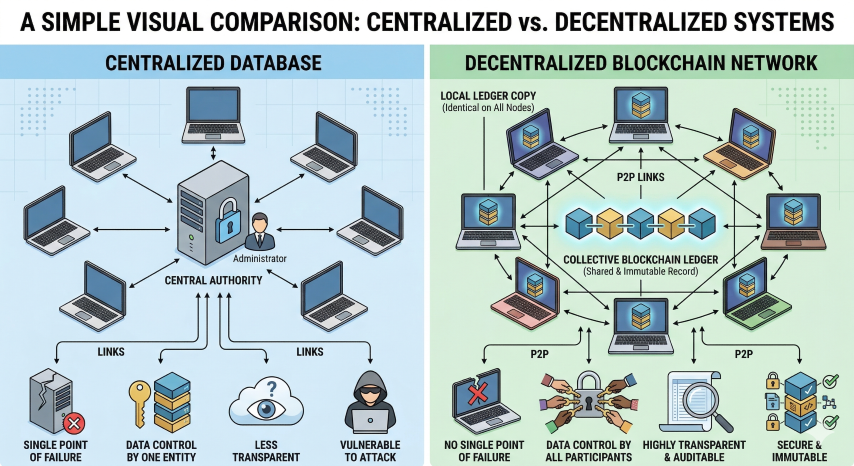
A blockchain removes the central database. Instead, thousands of independent computers (nodes) all run the same software and keep a copy of the exact same database. When a new record (transaction) needs to be added, the network uses a consensus mechanism to agree on its validity before it gets cryptographically sealed into a "block" and appended to the chain.
Because everyone has a copy, and because every block is mathematically linked to the previous one, changing historical data is practically impossible.
2. Reaching Agreement (Consensus)
In the apps we use every day—like Instagram or your bank—there is one central authority that decides what’s true. In a decentralized network, there is no "boss." Instead, thousands of strangers need a shared set of rules to ensure they don't end up with conflicting versions of history. We call these rules Consensus.
Here is how different networks stay on the same page:
- Proof of Work (PoW): A global race to solve a difficult math puzzle. The winner gets to update the database.
- The Logic: It makes writing to the database so expensive (in electricity) that it’s not worth it to lie. It’s essentially Massive-Scale Rate Limiting. (e.g., Bitcoin)
- Proof of Stake (PoS): Instead of burning electricity, you lock up your own money as a "security deposit." If you try to cheat the system, the network takes your deposit.
- The Logic: You’re putting Skin in the Game. You have a financial reason to be honest. (e.g., Ethereum)
- Delegated Proof of Stake (DPoS): Users vote for a small group of "representatives" to do the heavy lifting of updating the database.
- The Logic: Think of it like a Board of Directors. It’s much faster because fewer people are involved in the decision-making. (e.g., Polygon)
- Practical Byzantine Fault Tolerance (PBFT): Everyone votes in rounds. Once 2/3 of the group agrees, the data is set in stone.
- The Logic: A Digital Handshake. It’s incredibly fast and final, making it a favorite for private business networks.
Once these rules are met, the database is perfectly synced for everyone. It’s public, transparent, and permanent. But while anyone can read the data, how do you prove you have the right to change it—like moving a specific digital balance?
3. The Great "Wallet" Misconception
Here is the biggest mental hurdle for new developers entering this space: A crypto wallet does not hold crypto. When people create a wallet, they often think they are "registering" an account on a network, or claiming a reserved but empty slot on the blockchain. This is incorrect. The blockchain has absolutely no idea your wallet exists when you create it.
Creating a wallet is a 100% offline mathematical operation. It is pure Asymmetric Cryptography.
- The Private Key: A massive, randomly generated string of numbers. This is the "key to the lock." If you lose this, you lose the ability to prove you own anything.
- The Public Key: Derived mathematically from your private key (usually using Elliptic Curve Cryptography).
- The Address: A hashed, shorter version of your Public Key. This is the "lock."
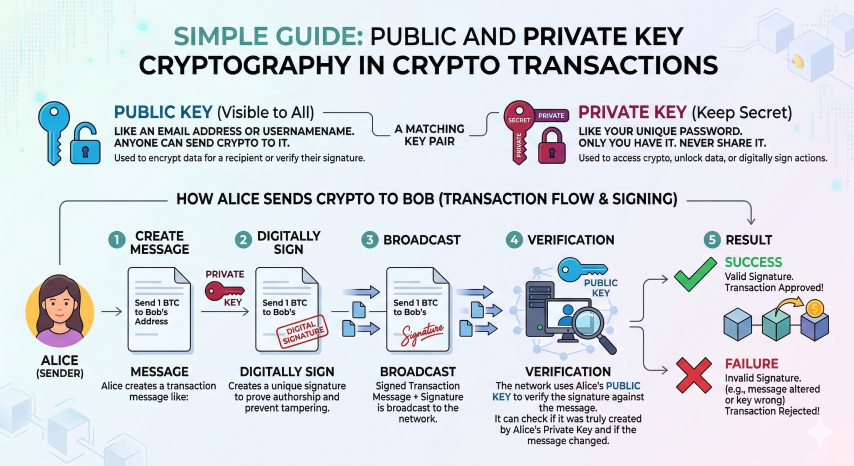
When someone sends you 1 ETH, the blockchain ledger simply updates to say: "Move 1 ETH from Address A, and assign it to Address B." Your wallet software (like MetaMask) simply scans the public blockchain, adds up all the transactions pointing to your address, and displays a balance. When you want to send that ETH, your wallet uses your offline Private Key to mathematically sign a transaction, proving to the network that you own the lock.
💻 Try it locally: Generating a Keypair
Because wallet creation is just math, you don't need the internet to do it. If you have Node.js installed on your machine, open your terminal and run this script to see how a pair of Elliptic Curve keys are born entirely offline:
// Run this in your Node.js environment or terminal REPL
const crypto = require('crypto');

// Generate an Elliptic Curve keypair (secp256k1 is used by Bitcoin/Ethereum)
const { publicKey, privateKey } = crypto.generateKeyPairSync('ec', {
  namedCurve: 'secp256k1',
  publicKeyEncoding: { type: 'spki', format: 'pem' },
  privateKeyEncoding: { type: 'pkcs8', format: 'pem' }
});

console.log("Your Private Key (Keep Secret!):\n", privateKey);
console.log("Your Public Key (Your Address derives from this):\n", publicKey);
Notice how you didn't need an API key, an internet connection, or a cloud provider? That is the essence of decentralization.
4. Coins vs. Tokens (Native vs. Smart Contracts)
Another common point of confusion is the difference between a Coin and a Token. While the media uses them interchangeably, technically, they are completely different beasts.
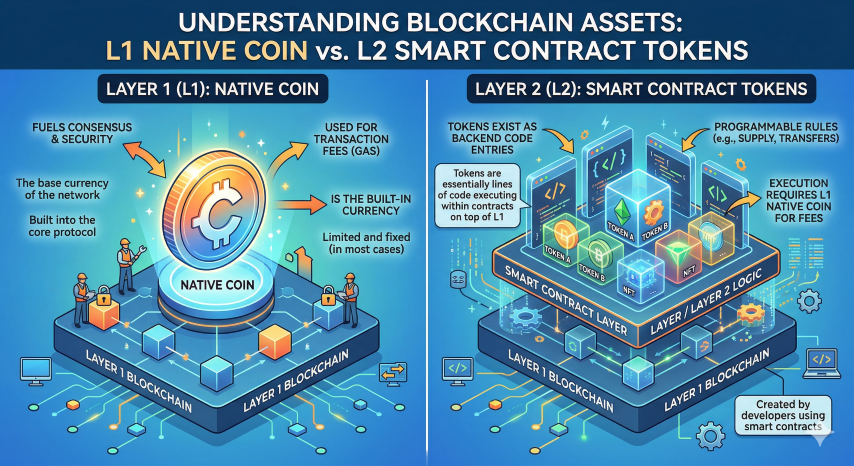
The Coin (Native Cryptocurrency)
A coin is the native currency of a specific blockchain.
- Examples: Bitcoin (BTC) on the Bitcoin network, Ether (ETH) on the Ethereum network.
- Purpose: Coins are built directly into the core protocol of the blockchain. They are primarily used to pay the network nodes for the computational work required to process transactions and run the network (often called "gas").
The Token (Smart Contracts)
Tokens are not built into the base level of the blockchain. Instead, they are created by Smart Contracts—which are simply pieces of backend code deployed onto the blockchain.
- Examples: USDC, Chainlink (LINK), or any NFT.
- Purpose: If Ethereum is the operating system, a Token is just an application running on it. When you transfer a token, you aren't moving the native currency; you are just telling a specific smart contract to update its internal spreadsheet to say your address now owns the token.
What’s Next?
So, a blockchain is just a shared database, your wallet is just an offline key to a cryptographic lock, and tokens are simply applications running on top of that database.
Now that we understand the foundational architecture, we need to look at what happens when this permissionless technology meets human psychology. In our next post, we will explore the dark side of Web3: how the lack of baked-in security controls allows bad actors to orchestrate rug pulls, the anatomy of hype, and how to spot a scam from a mile away.
Stay tuned!
Community Discussion
0 Comments
Found this helpful?
If you enjoyed this technical tale, consider supporting my work.